
I’ve run into this a lot in RPGs I genuinely love: I stop reading. I don’t know what anyone wants from me. I’m just mashing “accept quest,” following map markers, and going through the motions. Accept. Run. Kill. Follow the arrow. Get the reward.
And the strange thing is, the quests often still “work.” You don’t need to understand the story. You don’t need to remember names. You don’t need to think. The structure carries you. The game hands you a task, points you in the right direction, gives you a reward, and then does it again. Maybe it’s experience. Maybe it’s a weapon. Maybe it’s just a sound effect and a flash on the screen. Either way, you get the dopamine hit and move on.
I’m not above that. I enjoy those games too.
But sometimes I catch myself playing in a way that feels completely detached from the world itself. I’m not listening. I’m not making choices. I’m not roleplaying. I’m just consuming objectives.
And eventually I started asking a different question:
What if I don’t want to kill anything?
What if I just want to be a person in the world—someone who survives by paying attention, learning things, and using what they know?
That question is a big part of why I’m making Lowborn Rising.
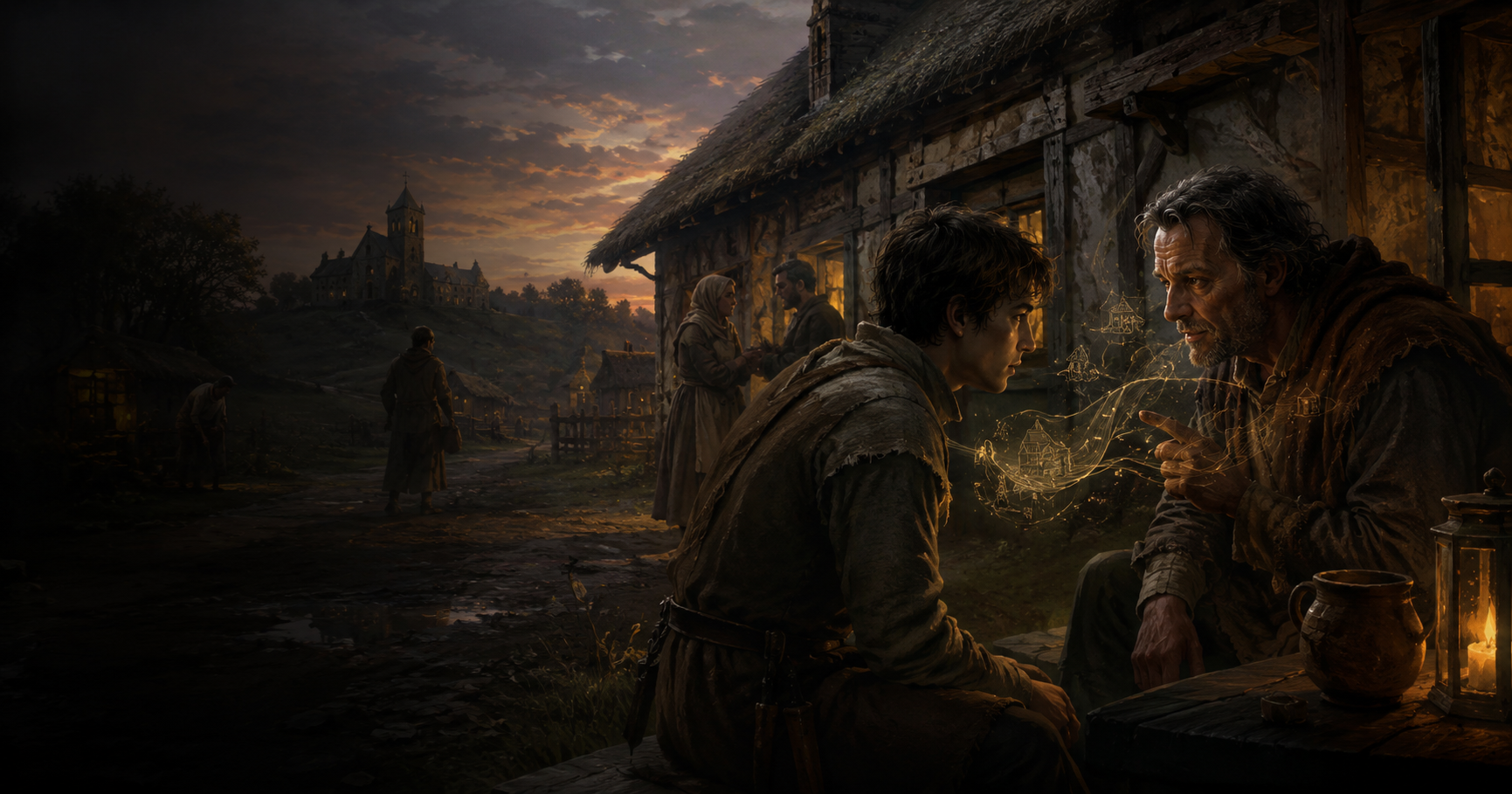
In Lowborn Rising, NPCs do not hand out quests like vending machines. They give you information. They tell you things. They reveal rumors, suspicions, needs, fears, opportunities, and pieces of the world. What you do with that knowledge is up to you.
That difference matters.
I want NPCs to feel like people, not objective dispensers. I want what they say to matter. I want players to actually listen, because the information they learn can be used in meaningful and unpredictable ways.
What happens if someone asks you to return a powerful sword, and you decide not to?
In many games, nothing really happens. The world just waits. The quest sits in your log forever, frozen in time until you choose to complete it. The sword exists only inside the boundaries of that quest.
I don’t want that.
I want a single piece of knowledge—or a single item—to have multiple possible uses. I want choices to create consequences. I want players to ask themselves not just, “How do I complete this?” but, “What can I do with what I know now?”
That’s the heart of the design.
Open-world RPGs often have bland characters, forgettable quests, and so much guidance that the sense of discovery gets smothered. You’re rarely lost, but you’re also rarely curious. The world becomes a checklist.
Dark Souls pushed against that in a powerful way. FromSoftware proved that players are willing—even eager—to be challenged, to pay attention, to learn through observation, failure, and discovery.
Lowborn Rising follows a similar philosophy, but in a very different form.
Instead of minimal direction in a world where you survive through combat, I want to build minimal direction in a world where you survive through social status.
You don’t progress because someone gave you a quest. You progress because you learned something—and knew what to do with it.